Note 03
Why the style points at the pole
The edge that casts the shadow on a good sundial is parallel to the earth's axis. Everything else follows from that.
Through the day the sun appears to turn around the earth's axis at a steady 15° an hour. If the edge that casts the shadow, the style, is parallel to that axis, then the plane through the style and the sun also turns at a steady 15° an hour, and the shadow moves in a regular way that can be marked once and for all.
Parallel to the axis means pointing at the celestial pole, the point in the sky that the stars turn around, close to the Pole Star. Its height above the northern horizon equals your latitude. So on a horizontal dial the style rises at an angle equal to the latitude.
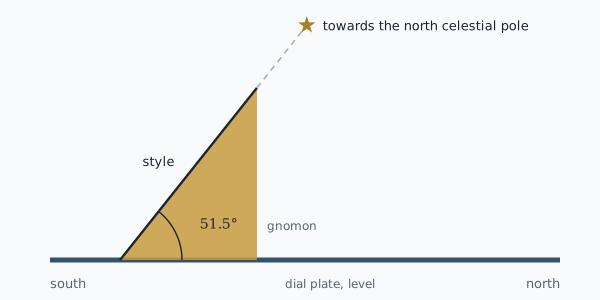
Two limiting cases make the rule easy to remember. At the north pole the axis is vertical, the style is a vertical stick, and the hour lines on a flat dial are spaced evenly, 15° apart. At the equator the axis lies flat, the style lies parallel to the dial, and the hour lines turn into parallel strips.
The triangular plate that holds the style up is the gnomon. Only its sloping edge matters for telling the time; the rest is support. Its thickness does matter: a thick gnomon has two edges, one used in the morning and one in the afternoon, so the dial has to be split along the noon line by the thickness of the plate.