Note 04
Hour lines on a horizontal dial
On a horizontal dial the hours are not 15° apart. One line of trigonometry says where they go.
The shadow of the style turns steadily, but it falls on a plate that is tilted relative to the axis it turns around, so the steady rotation is squeezed together near noon and stretched out near six o'clock. The angle X between the noon line and the hour line for t hours from noon is
tan X = sin(latitude) × tan(15° × t)
At 51.5° N the factor sin(latitude) is 0.7826, which gives these angles:
| Hours | t | Angle from the noon line |
|---|---|---|
| 11 am and 1 pm | 1 | 11.8° |
| 10 am and 2 pm | 2 | 24.3° |
| 9 am and 3 pm | 3 | 38.0° |
| 8 am and 4 pm | 4 | 53.6° |
| 7 am and 5 pm | 5 | 71.1° |
| 6 am and 6 pm | 6 | 90.0° |
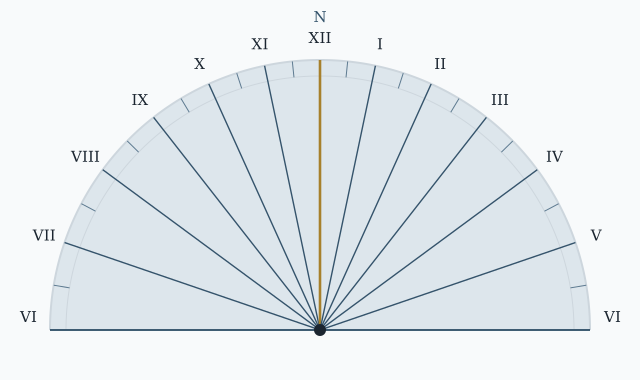
Six o'clock is always at 90°, a straight line across the dial through the foot of the style, whatever the latitude. In summer the sun rises before six and sets after six; the lines for five and four in the morning are the lines for five and four in the afternoon, continued backwards through the centre.
Setting it up
The dial has to be level and its noon line has to lie on the true meridian; the stick-and-circle method in an earlier note is good enough. A dial calculated for one latitude can be reused somewhere else by tilting the whole plate until the style is parallel to the axis again. Left flat, it reads wrongly away from noon.