Note 05
Why the sundial and the clock disagree
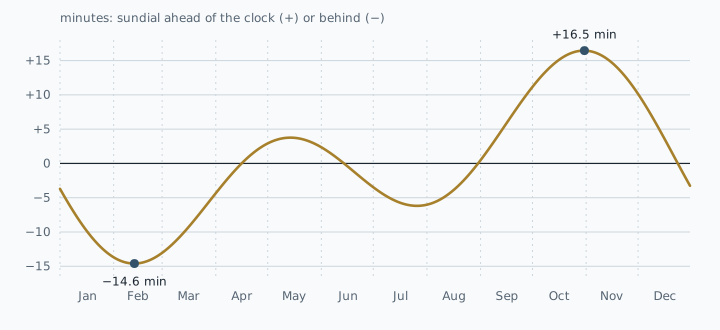
A sundial can be sixteen minutes ahead of the clock in November and fourteen behind in February, and neither of them is wrong.
Clocks keep mean time: every day is exactly 24 hours. The days measured by the sun, from one noon to the next, are not all the same length. Over the year the small differences pile up, and the sundial and the clock drift apart and back again. The difference, sundial minus clock, is called the equation of time.
There are two causes, and they add together.
- The orbit is an ellipse. The earth moves fastest in early January, when it is closest to the sun, so the sun appears to move further eastwards against the stars from one day to the next, and the solar day is a little longer than average.
- The axis is tilted. The sun moves along the ecliptic, which is tilted by about 23.4° to the equator. Near the solstices more of its daily motion runs east–west, near the equinoxes less, and only the east–west part moves the time of noon.
A good approximation, with N the day of the year and B = 360°/365 × (N − 81), is
E ≈ 9.87 sin 2B − 7.53 cos B − 1.5 sin B minutes
It is accurate to within about a minute, plenty for a garden dial. The difference is zero four times a year, around 15 April, 13 June, 1 September and 25 December, and reaches about +16 minutes at the start of November and −14 minutes in mid-February.
Two more corrections
To turn sundial time into clock time, subtract the equation of time, then add four minutes for every degree you are west of your time zone's meridian (subtract them if you are east of it), and add an hour in summer. In London, close to the Greenwich meridian, the longitude term is small.