Note 02
Finding true north with a stick
A vertical stick, a loop of string and two marks in the dust give a north–south line good enough to set a sundial.
A compass points to magnetic north, which differs from true north by an amount that depends on where you are and drifts from year to year. A sundial needs true north, and the sun will give it to you directly.
The classic method is sometimes called the Indian circle. Stand a straight stick vertically on level ground. In the morning, draw a circle around its foot with a radius equal to the length of the shadow, and mark where the tip of the shadow touches it. Through the morning the shadow shortens and the tip moves inside the circle; in the afternoon it grows again and crosses the circle a second time. Mark that point too.
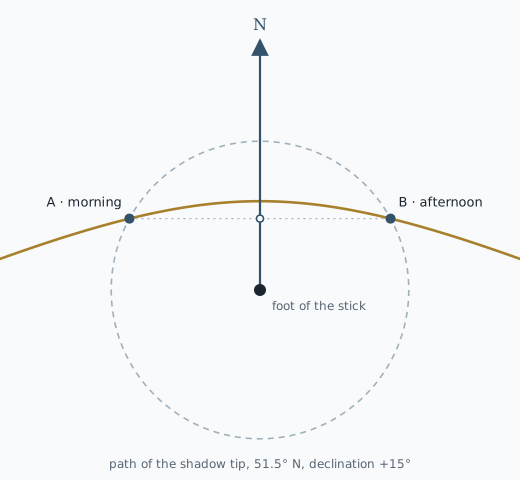
The sun's path is symmetrical about the meridian, so equal shadow lengths happen at equal times before and after noon. The two marks are mirror images of each other, and the line from the foot of the stick through the point halfway between them is the meridian.
Getting it right
- The ground has to be level and the stick vertical. A plumb line made from string and a nut is enough to check.
- A thin pointed tip, or a small ball on top of the stick, gives a sharper end to the shadow.
- Draw several circles of different radii and average the lines.
- Near the equinoxes the sun's declination changes by about 0.4° a day, which twists the result slightly. Around the solstices it hardly changes, and the method is at its best.