Note 01
Noon marks and meridian lines
Before clocks could be trusted, the most accurate timekeeper in a town was often a brass line set into a floor.
Local solar noon is the moment the sun crosses the meridian, the north–south line through the sky directly overhead. At that moment shadows point due north, at least in the northern hemisphere, and the sun stands at its highest for the day. A noon mark is anything that records this moment: a scratch on a windowsill where a shadow edge falls, a painted line on a wall, a strip of brass on a floor.
The large versions are called meridian lines. A small hole high in a south-facing wall or roof lets in a spot of sunlight, and a straight line on the floor runs due north from the point directly below the hole. Every day at noon the spot crosses the line.
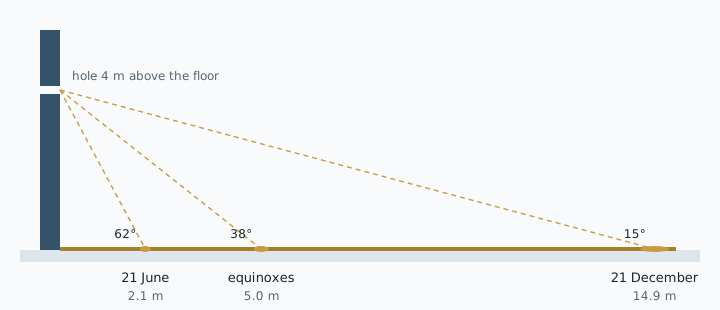
Because the noon sun is high in summer and low in winter, the spot moves along the line through the year. Mark where it lands on the solstices and the line becomes a calendar as well as a clock.
Big lines
The best known is in the basilica of San Petronio in Bologna, laid out by Giovanni Domenico Cassini in 1655. The hole is about 27 metres above the floor and the line is about 67 metres long. Measuring the size of the sun's image on the line at different times of year showed how the earth's distance from the sun changes, which was evidence for Kepler's elliptical orbit.
Noon by the line is not 12:00 by the clock. The difference has two parts: how far you are east or west of the meridian your time zone is based on, and the equation of time, which has a note of its own.