Note 07
Vertical dials on a south wall
The commonest dial in Britain is painted on a wall, and its hours run the other way round.
On a wall facing due south the style still has to be parallel to the earth's axis. It sticks out of the wall and points downwards, towards the south celestial pole below the horizon, at an angle of 90° minus the latitude to the wall: 38.5° here.
The hour lines hang down from the foot of the style, and the rule for them is the horizontal one with a cosine in place of the sine:
tan X = cos(latitude) × tan(15° × t)
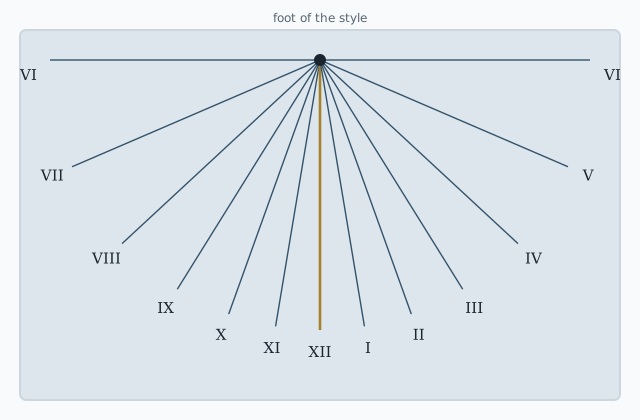
Two things surprise people. The shadow moves anticlockwise, because you look at the dial from the south rather than from above. And a south wall never sees the sun before six in the morning or after six in the evening, solar time; in summer the sun is still north of east at six, behind the plane of the wall, so the useful window is shorter still.
Few walls face exactly south. A wall that turns a few degrees east or west needs a dial calculated for its own orientation: the noon line is still vertical, but the style no longer stands above it and the hour lines lose their symmetry. Finding which way the wall really faces, by marking a shadow at known times, is usually the hardest part of the job.